
Showing posts with label Britain. Show all posts

Monday, July 30, 2012

Cat's Eye

Born in 1860 with a cleft lip, Louis Wain did not receive an education until age ten, thanks to the dubious advice of a family doctor who felt it wouldn't be suitable for young Wain to be around other children. After finally enrolling in school, Wain usually cut classes and spent his time exploring London.

Given this background, it is surprising that Wain developed into a talented artist. As a young man he supported his family through freelance illustration work, focusing on pastoral scenes. However, the field of freelancers was crowded, and Wain struggled to find prominence.

In 1883, he married Emily Richardson, but their happiness turned to tragedy when she became ill with cancer three years later. They found some comfort in the companionship of their much-loved pet cat, and Wain was inspired to make some cat drawings.
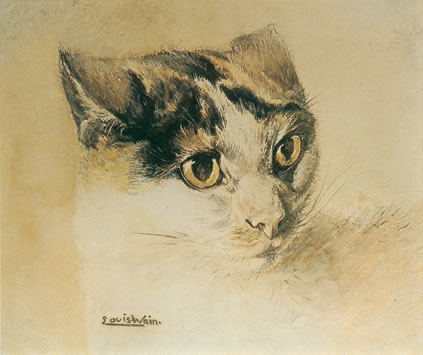
While his earliest illustrations were entirely naturalistic, Wain transitioned to amusing cartoons of anthropomorphised cats in order to boost his wife's spirits. Before she died, Emily Wain made her husband promise to continue drawing cats. Despite his grief, he devoted himself to his work. Gradually, the cats became even more human and were shown playing soccer, planning parties, and other merry activities. Wain submitted these illustrations to various newspapers, and eventually a Christmas-themed piece was bought by the London Illustrated News. There followed a flurry of production, in which Wain's illustrations were featured in several newspapers, magazines, and countless greeting cards. Unfortunately, Wain was credulous and naive when it came to the sale his artwork, and as a result he frequently received inadequate compensation. Often he lost the rights altogether.


After a stint in New York City doing a cat-themed comic-strip for the loathsome William Randolph Heart, Wain found himself broke and unable to sustain the whimsy of his previous work. He returned to London, where he learned that his mother had died in the 1918 flu pandemic. Unable to cope with his grief, Wain began to fray at the seams and his mental health declined. Accordingly, his cats no longer beamed with humor, and instead radiated paranoia and dread. Wain's relationship with his sisters deteriorated as he became obsessive, reclusive, and unstable.

By 1924, Wain had become violent and was committed to a mental institution. He spent the following years oscillating between calm lucidity and angry incoherence. The commonly accepted theory is that Wain had developed schizophrenia, but in lieu of a proper diagnosis it is impossible to tell what had happened to the poor man. When word spread that the once-famous illustrator was languishing in a drab hospital room, there was outrage amongst his fans and admirers, including such influential figures as the legendary science-fiction writer H.G. Wells.

At the behest of Wells and others, Wain was transferred to a far more a comfortable mental hospital. While Wain never recovered from his illness, the change of environment had a pronounced effect on him and his mood swings ended. Instead, he lived in quiet dementia, tending to a garden and caring for several pet cats that the hospital allowed him to keep. He also returned to art and produced many new beautiful illustrations. The pieces that he produced at the end of his life were highly abstract, and dazzlingly elaborate, and yet the familiar face of a cat is instantly recognizable.


Wain died on July 4th, 1939. His work is highly collectible, especially amongst both cat fanciers and psychology enthusiasts.


Monday, September 26, 2011

Nothing in the Dark

 In 1938, Halifax, England, was in the grip of terror. The frightened townspeople locked themselves in during the night and shops and taverns were closed down. The local police, together with Scotland Yard, prowled the alleyways and streets along with gangs of hard-edged vigilantes. 

A maniac was on the loose and no one could rest until he was caught.

In November 16th, two women, Mary Gledhill and Gertrude Watts, went to the police and described a narrow escape from a crazed man wielding a hammer. Their descriptions were vague, save that he wore shiny buckled shoes. News of the attack spread quickly and the town grew anxious. Five days later, police received a visit from one Mary Sutcliffe who tearfully told them that she had been attacked by a man armed with a razor. Other reports came in afterwards and Halifax exploded. The local newspapers shrieked warnings of the "Halifax Slasher" and more witnesses and near-victims came forward every day. Some accounts described a man armed with a hammer and others said he held a knife or straight razor. As their search turned up nothing, police offered a sizable reward for information leading the Slasher.  The drunken men of Halifax formed gangs to patrol the streets, and several innocent men were beaten after being mistaken for the elusive boogeyman. News of similar attacks came from nearby Bradford and Manchester. The town was at the boiling point. And then one of the victims came forward with a startling announcement:

His wounds were self-inflicted.

The manhunt had been unsuccessful, not due to some incredible cunning on behalf of the Slasher, but rather because there was never any Slasher in the first place. The whole story was a lie that was embellished upon by each subsequent "victim" until all of Halifax was in a frenzy. The newspapers that had capitalized on the Slasher scare made a quick about-face and happily informed their readers that there was no killer after all. Still, even after police had closed the case, reports of lunatics with razors and hammers were surfacing in towns as far away as London.

Tall-tales die hard, it seems.


But don't take my word for it!
-You can read about it in a book.

Wednesday, May 18, 2011

The Asteron Transmission

If you're like me, than you love stories of strange broadcasts. You also think that rayon is the ideal summer fabric and speaking to people on the phone "creeps you out," but that's irrelevant. This particular account of signal hijacking comes the UK.

On Saturday, November 26th, 1977, at 5:10 PM, Southhampton viewers of the early evening news were alarmed to find that the audio that ought to have accompanied the broadcast had been replaced by an entirely different transmission:

"This is the voice of Asteron. I am an authorized representative of the Intergalactic Mission and I have a message for Earth. We are beginning to enter a period of Aquarius and there are many corrections which have to be made by Earth people. All your Weapons of Evil must be destroyed. You only have a short time to learn to live together in peace. You must live together in peace or leave the galaxy."
The local station, Southern Television, was inundated with calls about the incident and police had to be dispatched to calm at least one panicked television viewer. The exact method through which the signal was interrupted remains unknown to this day, although the design of the UHF station's transmitters made it particularly vulnerable to hijacking and the act would have been a straightforward task for anyone with enough technical know-how.

The event was publicly acknowledged by the Independent Broadcasting Authority the next day and the novelty of the story ensured its wide dissemination across the news organizations of the world. Several tabloids, whether through sloppy reporting or a deliberate attempt to sensationalize the story, elaborated upon the transcript with various b-movie threats of annihilation from the stars.

Despite the sheer implausibility of an alien trying to convey a message to the people of Earth via a UHF television station based in Hannington, England, many people decided that the transmission was truly of extraterrestrial origin. The event probably would have faded into obscurity if not for these dedicated delusionals, who continue to discus the implications of Asteron's message on various internet message forums. Meanwhile, the "period of Aquarius" has never felt more distant.

Would you like to know more?
-Read this article from the Rome News-Tribune
-Read this article form the Ellensburg Daily Record

Wednesday, July 01, 2009

The Phantom Broadcast

KLEE-TV was the first television station in Houston, Texas, and the 12th in the nation. Constructed in 1949, it was purchased one year later by the publishers of the Houston Post to compliment their radio station. In light of this change in management, the station's call letters were later changed KPRC-TV.

Nothing worthy of the Hyper-Kitchen's notice happened at station KPRC until 1953, when they received a letter from Britain addressed to the "president of KLEE." Enclosed was a photograph of a television set displaying the KLEE station identification card. The accompanying letter explained that the picture was taken on September 14th, 1953 and requested an explanation. The station was baffled. Disregarding that the signal could not have possibly travelled all the way to the UK, and that American and British television receivers were incompatible, the KLEE identification card had not been used since the Post had bought the station.

The photographs were examined and deemed genuine. As various engineers and television experts tried to determine how the incident had happened, word got out. An article was written about the KLEE photo in a 1958 issue of Reader's Digest, and C.B. Colby devoted a chapter to KLEE in his 1959 book "Strangely Enough!". From there the story spread via word of mouth, and as per usual, was distorted with each retelling. Certain facts were ignored and fallacies were inserted. The details of the case were exaggerated; now the KLEE ID card had been seen by "viewers in many parts of England" and KLEE had been "off the air for years." It had developed a feel similar to a ghost story, with a phantom broadcast in the place of any undead specter. Perhaps this is why the story has endured for so long.

The staff at KPRC responded to the letter they received, asking for more information. The response was bizarre; little more than an advertisement for a mythical "super-heterodyne" television set that could receive signals over vast distances. Comparing notes with other television stations across the country, KPRC found that the others had received similar letters and photographs, and concluded that an unknown party in Britain had concocted the stunt to scam people into purchasing their non-existent "super-heterodyne" television sets. Whoever they were, they were relying upon out-of-date information, which explained why the picture showed the KLEE ID card and not KPRC.


It is deeply unfortunate that such a strange little mystery must be revealed as a mere hoax. The old phrase "the truth is stranger than fiction," is not so often the case.


Would you like to know more?
-The ever-intrepid Snopes.Com examines KLEE
-For whatever its worth, the official site of KPRC-TV, formerly KLEE-TV
-Buy C.B Colby's "Strangely Enough!" for a single cent (a steal)